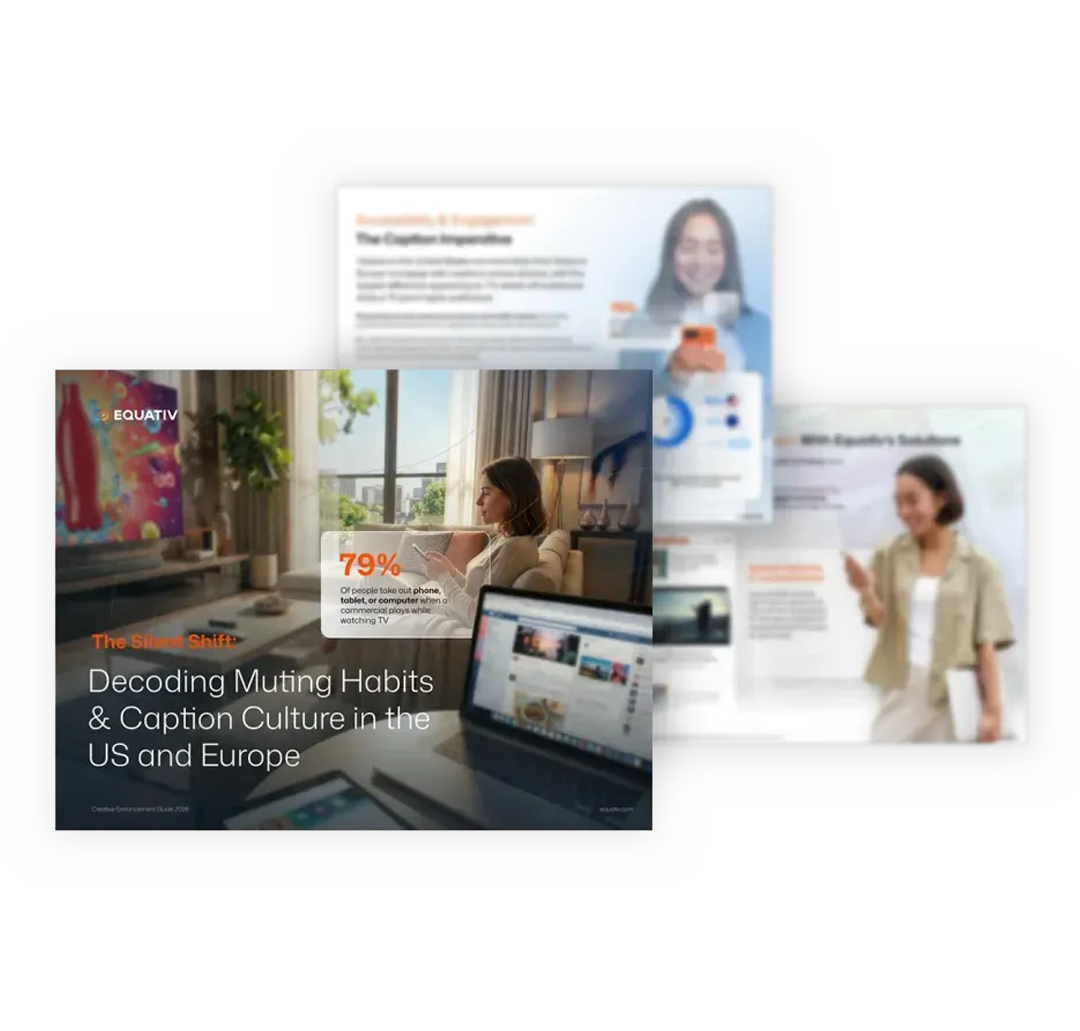
In today’s mute-first, multi-screen world, ad success depends on instant understanding. Learn how creative ad enhancements like captions, text placement, and overlays boost video ad comprehension and performance.

In a world of muted video, endless scrolling, and split-screen attention, the ads that perform best aren’t the ones that appear most often; they’re the ones people immediately understand. Visibility alone no longer guarantees impact; a screen isn’t a mind, and appearing on it doesn’t mean your message is received.
To understand why, we conducted a cross-market study of video viewing behaviors and creative performance across the U.S. and Europe. We examined how muting habits, captions, screen attention, and creative design influence whether viewers instantly grasp an ad’s message. The results are clear: in today’s fast, silent, multi-screen environment, performance is driven not just by reach, but by how effectively creative is designed for human comprehension.
Marketers have largely perfected delivery. The real challenge now is designing ads for how humans actually consume content. Our research shows that creative enhancements built for comprehension are becoming a primary driver of ad performance.
Today, mute has become the default. Our research shows that 74% of European consumers and 66% of U.S. consumers keep their phones on silent while watching videos in public, fundamentally changing how content is experienced. Even in private settings, the habit persists: 31% of Europeans and 24% of U.S. consumers still watch videos on mute at home. And this trend extends beyond mobile - nearly one in three users keep their computers muted while browsing social media or news sites.
Taken together, these behaviors reveal a new reality: we’re marketing in a silent world. Audio is no longer the primary delivery mechanism for video; it’s a secondary layer that only some viewers experience. To drive results, brands must design for the eye, not the ear.
If audiences consume media silently and at speed, creative must evolve to match how people actually process information.
Video should be designed so viewers can grasp the core message within seconds, even without sound. Our research highlights several creative enhancements that significantly improve comprehension and performance.
In a silent, scroll-driven environment, clarity becomes the new creative advantage.
Connected TV introduces a new version of the comprehension challenge: the second screen. With viewers splitting their attention between the TV and a phone or tablet, ads are no longer competing only with other commercials.
When commercial breaks start, attention often shifts away from the TV entirely. In fact, 79% of viewers say they often reach for another device when a TV commercial plays, and 66% say they’re more likely to avoid commercials when they appear.
To pull attention back to the primary screen, advertisers must deliver immediate visual value. Subtle elements like overlays, tickers, and countdowns give viewers something useful or interesting to notice, drawing attention back to the screen. When done well, these visual cues increase engagement, recall, and comprehension—helping ads break through even in a distracted, multi-screen environment.
Attention alone is no longer enough. In a silent, multi-screen world, advertising must reflect how people actually consume media, not how marketers once assumed they did. To drive consideration, recall, and purchase, ads need to prioritize human comprehension at first glance.
That means designing creative that is:
Together, these principles shift the goal of advertising from mere visibility to real understanding. Screens don’t buy products—people do, and people only act on messages they understand.In today’s fragmented, distracted media environment, the mandate is clear: stop buying impressions and start investing in human comprehension. The brands that win won’t just appear on screen—they’ll be the ones people instantly understand.
Summary
The End-to-End Media Platform Powering Attention, Quality and Outcomes