



Server-Side Ad Insertion (SSAI) and Dynamic Ad Insertion (DAI) are two sides of the same coin, or in this case the same technology.
Server-Side Ad Insertion (SSAI) is the technical concept used in online video streaming that describes advertising being inserted into the content at the server level in the cloud rather than at the player level (the client-side).
This means ads are stitched into the video stream before it reaches the viewer's device, typically utilizing a Content Delivery Network (CDN) in combination with an Ad Server, and an SSAI platform like Serverside.ai. The method allows for a seamless viewing experience without the very common buffering issue or delays caused by ad loading in online streaming environments.
Dynamic Ad Insertion (DAI), on the other hand, is the business concept referring to the fact that ads are dynamically inserted into the content stream in real-time based on various targeting criteria. Unlike traditional TV broadcasting where ads are usually predefined and served to all viewers identically, DAI allows for the personalized delivery of ads to individual viewers or households.
This targeted ad insertion process can potentially take place both at client-side or server-side level but — nowadays — Dynamic Ad Insertion (DAI) is usually used as a synonym of Server-Side Ad Insertion (SSAI).
To implement SSAI / DAI properly, ad slots within the content need to be marked either with SCTE-35 ad markers (live linear) or cue points (VOD). This way, when a viewer requests a video, the ad insertion system — in collaboration with Ad Servers and Supply-Side Platforms or SSPs — dynamically selects and inserts the most relevant ad into the reserved slot based on factors such as viewer demographics, interests, location, and behavior.
This ensures viewers receive ads that are tailored to their preferences, leading to higher engagement and conversion rates that positively affects both advertisers and TV publishers who can now ask for premium fees for micro targeted advertising placements.

Server-Side Ad Insertion is a newer and more optimized ad delivery method compared to the traditional Client-Side Ad Insertion approach. As said, SSAI involves stitching ads into the video stream at the server level before reaching the viewer's device, ensuring seamless playback without interruptions. In contrast, CSAI inserts ads on the client side, relying on the capabilities of the viewer's device and player. Therefore, this technology is more susceptible to buffering or delays caused by ad loading and communication with the ad server. In addition, CSAI delivers ads in their original format, which may not be optimized for the viewer's device or connection speed, while with SSAI the ads are transcoded and optimized for the specific device and bandwidth of the viewer.
Server-Side Ad Insertion makes it also more difficult for ad-blockers installed on the client machine to block ads. This is because the ads are delivered as part of the video stream, and not as separate requests. In contrast, Client-Side Ad Insertion requires a separate request to be made for each ad, which can be easily detached by ad-blocking software.
Overall, SSAI provides a significantly enhanced ad experience compared to CSAI due to its ability to reduce ad latency, prevent ad blocking, and provide higher-quality ads and more accurate analytics resulting in a greater monetization potential for TV operators.

Server-Side Ad Insertion (SSAI) can be used both for live streaming and on-demand content (VOD), offering versatile monetization capabilities for media operators and publishers.
In the context of live streaming, SSAI enables real-time ad insertion into live feeds, ensuring seamless integration of ads without interrupting the viewing experience. This is crucial for events such as sports matches, news broadcasts, concerts, and gaming streams, where advertisers can target a large, engaged audience.
Similarly, for on-demand content like movies, TV shows, and archived videos, SSAI allows for Dynamic Ad Insertion based on viewer demographics, interests, and behaviors. By stitching ads server-side into the video stream, SSAI ensures optimized ad targeting, better ad completion rates, and improved monetization potential also for VOD platforms.
Overall, SSAI provides a unified solution for delivering targeted advertisements across live streaming and video-on-demand, enabling TV publishers to maximize ad revenue and enhance viewer engagement for synchronous and asynchronous video content.

"For their large-scale sports events, our customers rely on us partnering with scalable ad insertion solutions such as Serverside.ai. Their cloud based architecture allows us to scale to peak concurrency while also staying economical in VOD environment or during periods of lower viewer numbers."- Pavlin Rahnev, CEO at PlayboxNeo (playout provider)
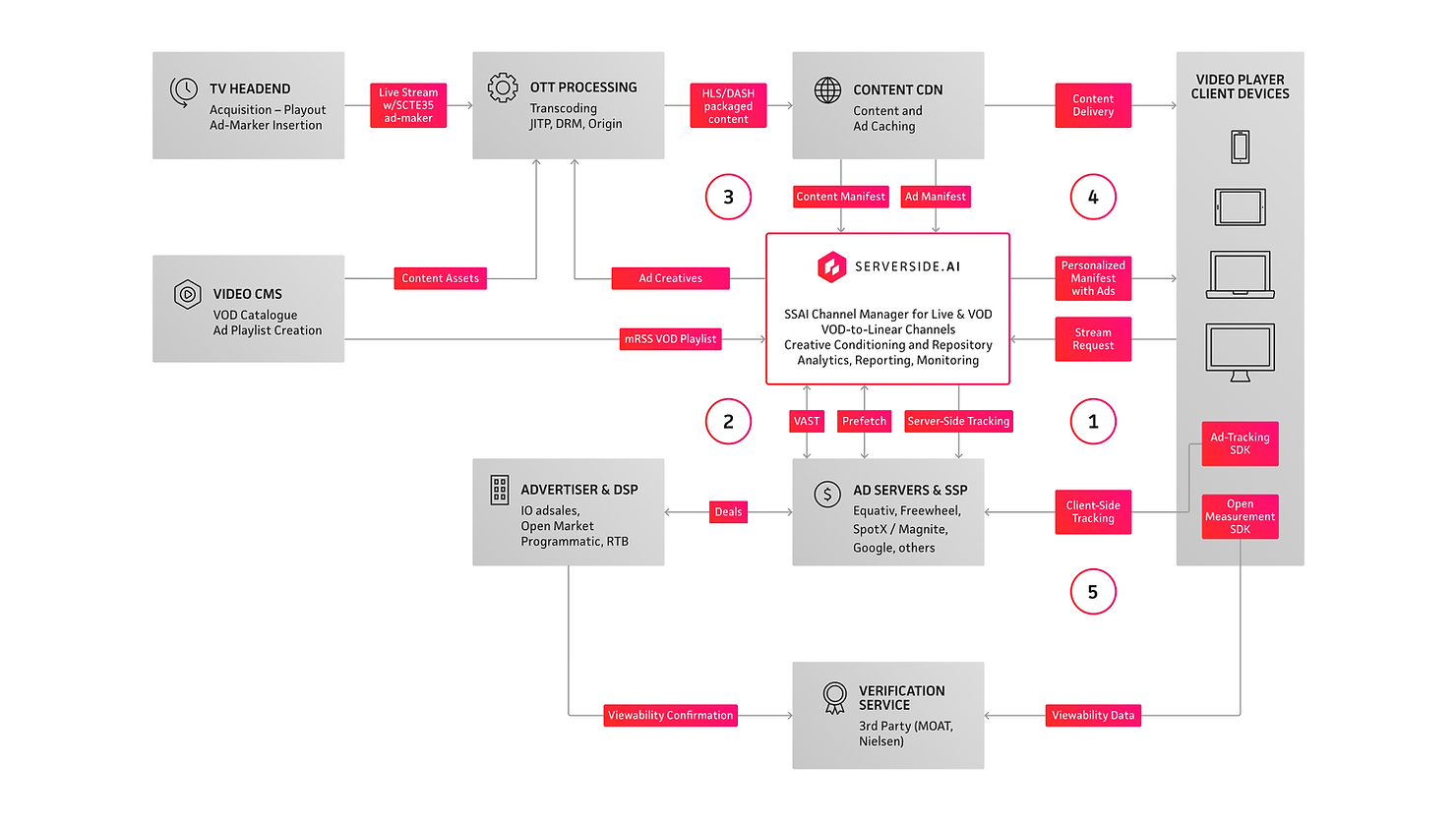
Server-Side Ad Insertion (SSAI) involves a series of technical processes that seamlessly integrate advertisements into the content stream before delivering it to viewers. Here's how SSAI typically works from a technical perspective:

“The ecosystem of server-side ad insertion (SSAI) is highly complex and involves different partners for the best monetization possible. Besides numerous technical integration partners, there are almost the same amount of standards and formats. This requires strong partnerships between the server-side ad insertion providers, the ad servers, and the supply-side platforms (SSPs), and as well for the player and client-side beaconing (CSB) SDK to achieve a seamless integration and best performance. This strong basement is crucial for fine tuning in increasing the yield for contextual advertising or socio-demographic targeting. To maximize monetization, enriching request data to ad servers is essential, but this must be balanced with the strict protection of each user's data privacy”.- Georg Senzenberger, Head of Product and Platform at Serverside.ai

Implementing Server-Side Ad Insertion (SSAI) requires platform operators to meet specific technical requisites to ensure successful integration and usage. Here we listed the key technical requirements for video publishers to deploy SSAI:

“The Serverside.ai team always ensures that the sources provided by our customers for live and video on demand are compatible with our software and we provide them punctual feedback on what to adjust. Once this is done, we analyze the sources again and perform tests in our test and productive environments. Nothing is left to chance.”- Denis Hoehne, Director of Operations at Serverside.ai

Server-Side Ad Insertion (SSAI) enables sophisticated ad targeting and personalization by leveraging viewer data and real-time decision-making capabilities. Here's how SSAI handles ad targeting and personalization.

""At Warner Bros. Discovery we are experiencing substantial revenue growth thanks to targeted dynamic advertising in our linear TV channels. By delivering personalized ads directly, we ensure that advertisements stay highly relevant for the addressed households. This targeted approach not only enhances viewer engagement and satisfaction but also maximizes ad effectiveness, leading to higher conversion rates and — subsequent — increased advertiser spending."- Samuele Macchi, Technical Director Digital Advertising Services - EMEA at Warner Bros. Discovery

In collaboration with Ad Servers and SSPs, Server-Side Ad Insertion (SSAI) offers robust capabilities for managing ad podding and frequency capping, which are essential aspects for optimizing the ad experience within premium video content streams. But let’s see these two components in detail.
An ad pod is a group of ads sequenced in a row to be played back-to-back during a single ad break. TV publishers schedule ad breaks at strategic intervals and with specific durations within the video stream to ensure a balanced and legally regulated mix of content and ads.
At the same time, SSAI platforms dynamically group the ads coming from the ad server into pods based on parameters such as ad length, ad slot requirements (e.g., pre-roll, mid-roll, post-roll), and viewer engagement metrics (by dynamically adjusting ad pod composition and scheduling based on real-time viewer interactions and behavior patterns). Then ad pods are seamlessly integrated into the video stream server-side, allowing for smooth transitions between content and ads.
Frequency capping is the practice of limiting the number of times a viewer is exposed to a specific ad within a defined period. SSAI platforms facilitate frequency capping triggered by the ad-server, preventing ad overexposure (and consequent ad fatigue) while enhancing ad relevance.
Platform operators can define frequency capping rules themselves based on viewer segments, ensuring that no viewer is subjected to the same ad excessively, or they can rely on the limits set by the ad server / SSP. Frequency capping policies are then followed by the SSAI platform, allowing for consistent ad delivery across different platforms and devices.
As stated before, SSAI platforms track ad impressions and viewer interactions in real-time so it is easy for them to monitor the effective ad exposure for the publishers to make the necessary adjustments where needed.

“Ad podding is an important mechanism to enable SSAI handling all ads for one break with one request only. The ad insertion experience is smooth, publishers can control their ad delivery more precisely and this leads to increased monetization. Frequency capping offers viewers variety whilst it also allows them to keep certain ads in mind. With that comes a huge improvement in user experience avoiding repetition and keeping the engagement of viewers high at the same time”.- Anne Georgi, Ad Operations Manager at Serverside.ai


Server-Side Ad Insertion platforms offer comprehensive analytics and reporting capabilities to support content owners and advertisers in understanding ad performance, optimizing campaigns, and making informed decisions.
These platforms can provide insights into ad impression and ad campaign performance, viewer engagement, audience demographics and behaviors, and quality of service metrics. SSAI enables real-time monitoring of ad delivery status and offers customizable dashboards for visualizing data and generating automated reports.
Additionally, Server-Side Ad Insertion platforms facilitate integration with third-party analytics software, such as MediaMelon’s and IAB’s, to enable comprehensive reporting and analysis.
To give a concrete example of the metrics monitored by SSAI platforms, these are the main KPIs considered by and available in Serverside.ai:

“The detailed analytics provided by SSAI platforms, such as Serverside.ai, empower users with a comprehensive understanding of their ad performance, enabling real-time adjustments and long-term strategic planning. This level of insight ensures that advertising efforts are both efficient and effective, meeting the evolving needs of publishers and advertisers.”- Mohammad Hammoud, Lead Full-Stack Engineer at Serverside.ai

Server-Side Ad Insertion (SSAI) platforms strive to comply with industry standards and regulations, including data privacy laws such as the General Data Protection Regulation (GDPR) in Europe and the California Consumer Privacy Act (CCPA) in the United States (besides other states who also strive towards privacy enhancements). Compliance with these regulations is essential to protect viewer privacy and ensure responsible data handling practices within the context of ad serving and audience targeting. Especially in an era with lots of uncertainty around how walled gardens handle privacy issues, it is fundamental to provide answers to the increasing concerns that viewers have around the world. Here's how SSAI platforms typically address data privacy requirements:

“In today’s digital advertising landscape, the security of SSAI platforms is paramount. These platforms handle vast amounts of sensitive data and play a critical role in delivering personalized ad content. As such, maintaining stringent security measures and compliance with industry standards is essential to protect against potential cyber threats and data breaches. Serverside.ai has obtained A+ in Astra Security pentest rating. This achievement underscores the company's commitment to implementing best-in-class security practices, including robust encryption, access controls, and comprehensive data protection measures.”- Shikhil Sharma, CEO at Astra Security (cyber security company)

Choosing a Server-Side Ad Insertion Solution is not an easy task as this choice is directly connected with the monetization potential of a streaming platform / OTT video publisher.
The decision-makers in those companies have to consider several key factors based on the points we analyzed in the previous paragraphs but not limited to those.
Generally speaking, when selecting an SSAI solution prioritize platforms that have the following attributes:
Efficient manifest manipulation is key in SSAI. It enables dynamic modification of video manifests for seamless ad insertion, reducing latency without requiring additional client-side requests or delays, and offering precise control over ad placement (e.g., pre-roll, mid-roll, post-roll) and ad durations.Optimized manifest manipulation clearly enhances the scalability of SSAI solutions. By efficiently managing manifest modifications on the server side, platforms can handle large volumes of ad requests and concurrent viewers without performance degradation. This scalability is essential for delivering ads seamlessly across multiple devices and ensuring consistent ad delivery under varying traffic conditions.
While not all aspects of SSAI directly involve VAST (especially when considering server-side ad stitching and delivery), VAST compliance is crucial for facilitating the interaction between SSAI platforms and ad servers, ensuring proper ad delivery, tracking, and measurement within video content streams. This adherence to industry standards enhances the overall effectiveness and efficiency of SSAI implementations in digital advertising workflows.
An SSAI platform that is, as far as possible, technology-agnostic and able to answer to the different and evolving customers’ requirements is definitely preferable in a fast-changing environment like MediaTech.A software that is customizable and easily adaptable to your existing streaming infrastructure, CDN, ad server(s), and SSP(s) will definitely save your tech department precious time (and headaches)!Also ensure that the chosen solution is compatible with various devices and platforms (CTVs, set-top boxes, apps, web, mobile, etc.).Existing integration with major ad-networks will further increase the efficiency of set-up and processes.
For a TV operator or publisher, selecting an SSAI vendor with a sharp focus on innovation is crucial in maintaining a competitive edge and delivering a superior viewer experience. An innovative SSAI vendor stays ahead of industry trends, continuously integrating new technologies and adapting to changing consumer behaviors. Speaking about emerging technologies, for example, you should keep an eye on the developments of Dynamic Ad Substitution in Broadcast, utilizing HbbTV in Europe and ATSC 3.0 in the US (now renamed to “NextGenTV”). Also observe Server-Guided Ad Insertion (SGAI) which combines the advantages of SSAI and CSAI to provide a more efficient ad delivery process, and DCO (Dynamic Creative Optimization) which dynamically customizes ad components, such as images, text, and calls-to-action, to create tailored creatives that are highly relevant to individual viewers. Also GenAI will heavily influence the creation and delivery of video ads short term.
When selecting an SSAI solution, also bear on the top of your mind both security and privacy compliance. Opt for a platform with robust security measures, including encryption, access controls, and data retention policies, to safeguard user data and ensure reliable ad delivery. Make sure that the SSAI solution prioritizes privacy compliance by adhering to regulations like GDPR and CCPA. Look for platforms supporting robust user consent management, data minimization practices, anonymization of personally identifiable information (PII), and transparent data handling practices to protect user privacy and build trust with viewers.
Apart from these 5 pillars, always pay attention to the vendor reliability and industry reputation, the quality of the customer support, and the pricing model that should always be transparent and based on usage, ad impressions, or other definable metrics.
Serverside.ai has a simple pricing structure with a transparent CPM model, reflecting regional differences in the CPMs achievable by publishers, without additional costs for infrastructure or bundled product prices. Our solution is VAST compliant and rated A+ for security, technology agnostic, and pre-integrated with top-tier ad-networks.
In addition to that, we cooperate actively with the most important technology consortiums and research institutes such as IAB Tech LAB and Fraunhofer FOKUS to always be one step ahead regarding quality and innovation.To give a concrete example, we are already working to integrate the rising solutions we mentioned in this paragraph into our offering in combination with our cutting-edge HbbTV DAS (Dynamic Ad Substitution) thanks to which we leverage the broadcast and the digital world together, holistically serving tier 1 customers in their whole product portfolio.
For these reasons, large TV players like Warner Bros Discovery, Deutsche Telekom MagentaTV, and A1 Austrian Telekom are already counting on our SSAI platform.
Contact us if you want to know more about how we prioritize the different aspects of Server-Side Ad Insertion and Dynamic Ad Insertion underlined in this article.
Summary
As Content Marketing Manager at Equativ, Roberta manages and executes a wide range of content initiatives, including social media, PR, blog posts, SEO/GEO, and case studies. She also supports event coordination across Italy and Spain. On the Equativ blog, she authors and collaborates on pieces ranging from product innovations to industry trends, with a specialized focus on the CTV landscape.
The End-to-End Media Platform Powering Attention, Quality and Outcomes


